Scalable Vector Database Architecture
Embedding search is easy at 10K vectors. At 100M vectors with sub-100ms P99, it's an infrastructure problem — and that's what this pattern solves.


When You Need This
Your RAG pipeline or recommendation system works beautifully in development with a few thousand vectors. Now you have 50 million embeddings, queries need sub-100ms latency, the index keeps growing, and you're burning through memory. You need a vector database architecture that scales horizontally, manages memory efficiently (not everything needs to live in RAM), handles concurrent writes during ingestion without degrading query performance, and doesn't cost $10K/month in infrastructure for what is fundamentally a search index.

Pattern Overview
Scalable vector database architecture addresses the challenges of operating vector search at production scale: index partitioning across nodes (sharding), tiered storage (hot segments in memory, warm on SSD, cold on S3), query routing with load balancing, and autoscaling based on query load and index size. The pattern covers deployment topology, capacity planning, write/read isolation, and cost optimization. It's the infrastructure layer that makes RAG and recommendation systems viable at scale.

Reference Architecture
The architecture deploys vector database nodes in a clustered topology with separation between query nodes (read path) and data nodes (write path). An ingestion pipeline handles embedding generation and batch upserts with write buffering to avoid impacting query latency. A query router distributes searches across read replicas with shard-level parallelism. Tiered storage moves infrequently accessed segments from memory to SSD to S3, with transparent query-time loading. Autoscaling adjusts replica count based on query QPS and P99 latency.
- Cluster Management: Milvus (our default for scale) with etcd for metadata coordination, MinIO/S3 for segment storage, and Pulsar/Kafka for write-ahead logging. Alternatively, managed services (Pinecone, Zilliz Cloud) when operational simplicity outweighs cost
- Shard & Partition Strategy: Logical partitions aligned to data boundaries (per-tenant, per-document-collection, per-time-window). Each partition is independently searchable, enabling filtered queries without scanning the full index. Shards distributed across nodes for parallel query execution
- Tiered Storage Engine: Hot tier (in-memory HNSW/IVF index) for frequently queried collections. Warm tier (memory-mapped SSD) for large collections with moderate query load. Cold tier (S3-backed) for archival collections that are searchable but tolerate higher latency. Segment-level promotion/demotion based on access patterns
- Autoscaling Controller: Horizontal pod autoscaler (HPA) on Kubernetes that scales query nodes based on QPS and P99 latency metrics. Scale-up on latency breach, scale-down on sustained low utilization. Separate scaling for ingestion workers to handle burst uploads without affecting query performance

Design Decisions & Trade-offs
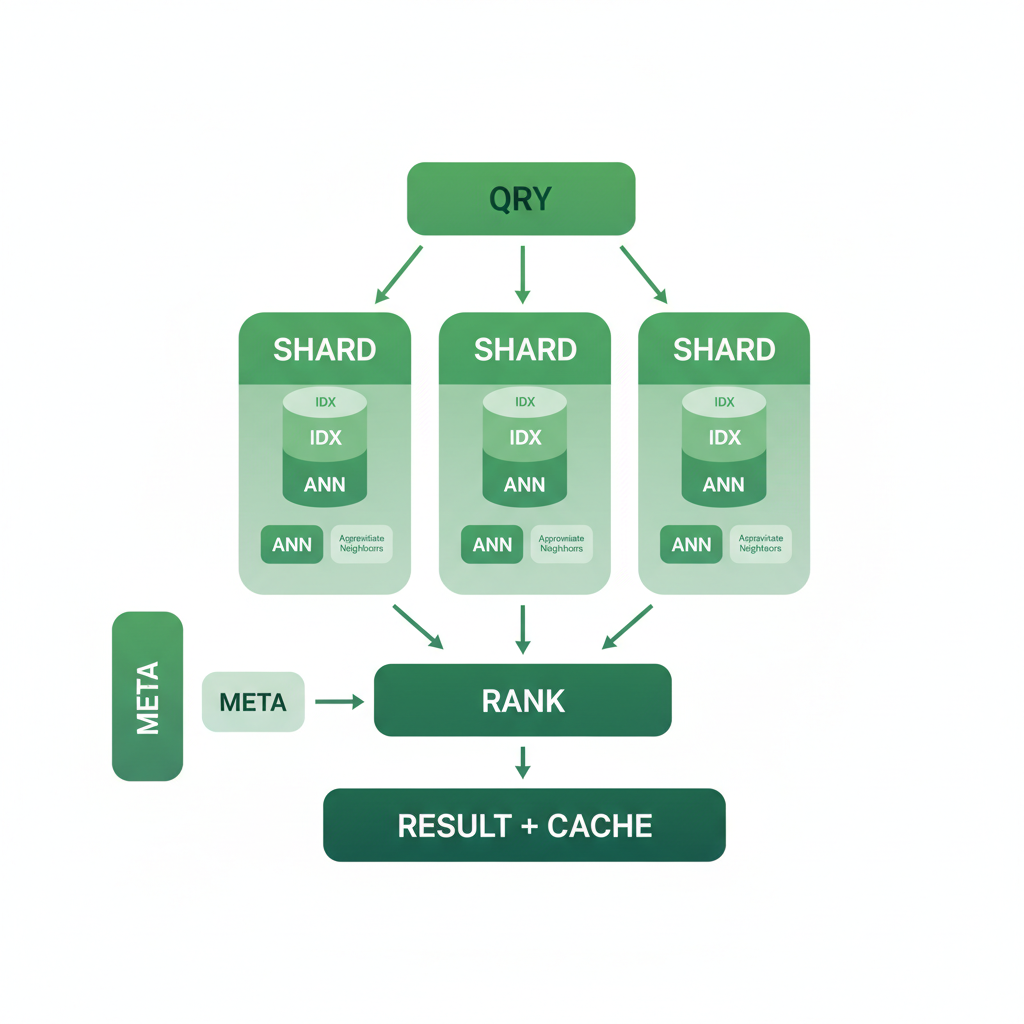
System Architecture Overview
Technology Choices
| Layer | Technologies |
|---|---|
| Vector Database | Milvus (distributed), Qdrant (single-node/small-cluster), Pinecone (managed) |
| Storage Backend | MinIO / S3 (segment storage), SSD (warm tier), RAM (hot tier) |
| Coordination | etcd (Milvus metadata), Pulsar/Kafka (write-ahead log) |
| Embedding Models | OpenAI text-embedding-3-large, Cohere embed-v4, BGE-M3, E5-large-v2 |
| Infrastructure | Kubernetes (EKS/GKE) with GPU nodes for embedding, memory-optimized nodes for query |
| Monitoring | Grafana + Milvus metrics exporter, custom P99/recall dashboards |
When to Use / When to Avoid
| Use When | Avoid When |
|---|---|
| Vector count exceeds 5M and growing, requiring horizontal scaling | You have < 1M vectors — pgvector on your existing PostgreSQL is sufficient |
| Sub-100ms P99 query latency is a hard requirement | Query latency of 500ms+ is acceptable — simpler options work |
| Multiple applications/tenants share the vector infrastructure | A single application with a single collection — use a managed service |
| Cost optimization requires tiered storage (not everything in RAM) | Budget allows fully managed services and the vendor's pricing works at your scale |
Our Approach
MW designs vector database infrastructure with a "right-size from day one, scale when measured" approach. We start with capacity planning based on vector count, dimensionality, index type, and target latency — not guesswork. Our Milvus deployments on Kubernetes include Grafana dashboards tracking segment count, memory utilization, query latency percentiles, and recall estimates. We've implemented autoscaling Milvus clusters that handle 10x traffic spikes during business hours and scale down overnight, reducing infrastructure cost by 40-60% compared to static provisioning.

Related Blueprints
- AI Customer Support Agent — Vector search powering knowledge retrieval for support responses
- AI Document Processing Pipeline — Embedding and indexing extracted document content
- AI-Driven Personalized Learning Platform — Vector similarity for content recommendations

Related Case Studies
- Milvus Autoscaling — Production Milvus cluster with Kubernetes HPA and S3-backed tiered storage
- Document Intelligence — Vector search for local document retrieval and analysis
Related Architecture Patterns
Explore more design patterns and system architectures

RAG Pipeline Architecture
Give your LLM access to your data without fine-tuning. RAG bridges the gap between general-purpose language models and domain-specific knowledge.

AI/ML Pipeline Architecture
Models don't run themselves. The pipeline that trains, validates, deploys, and monitors your models is the actual product — the model is just one artifact.

Data-Intensive Platform Architecture
When your competitive advantage is in your data, the platform that collects, transforms, stores, and surfaces that data is the most important thing you'll build.
Need Help Implementing This Architecture?
Our architects can help design and build systems using this pattern for your specific requirements.
Get In Touch