Back to Architecture Patterns

ApplicationAdvanced

Multi-Tenant SaaS Architecture

One codebase, hundreds of tenants, zero data leakage — the foundation of every scalable SaaS business.

May 2, 2026
|
3 topics covered
Discuss This Architecture
Multi-Tenant SaaS Architecture
Application
Category
Advanced
Complexity
Healthcare, EdTech
Industries
3+
Technologies

When You Need This

You're building a platform that serves multiple customers from a single deployment. Each customer expects isolated data, branded experiences, and per-tenant billing — but you can't afford to run separate infrastructure for each one. You need the economics of shared infrastructure with the isolation guarantees of dedicated systems. This is the fundamental tension of SaaS architecture, and getting the isolation model wrong early is one of the most expensive mistakes in platform development.

Pattern Overview

Multi-tenant SaaS architecture provides logical or physical separation between tenants while sharing underlying compute, storage, and networking resources. The pattern encompasses tenant provisioning, data isolation, feature management, billing metering, and white-label customization. The core design decision is the isolation model: shared database with row-level security, schema-per-tenant, or database-per-tenant. Each model trades off isolation strength against operational complexity and cost efficiency.

Reference Architecture

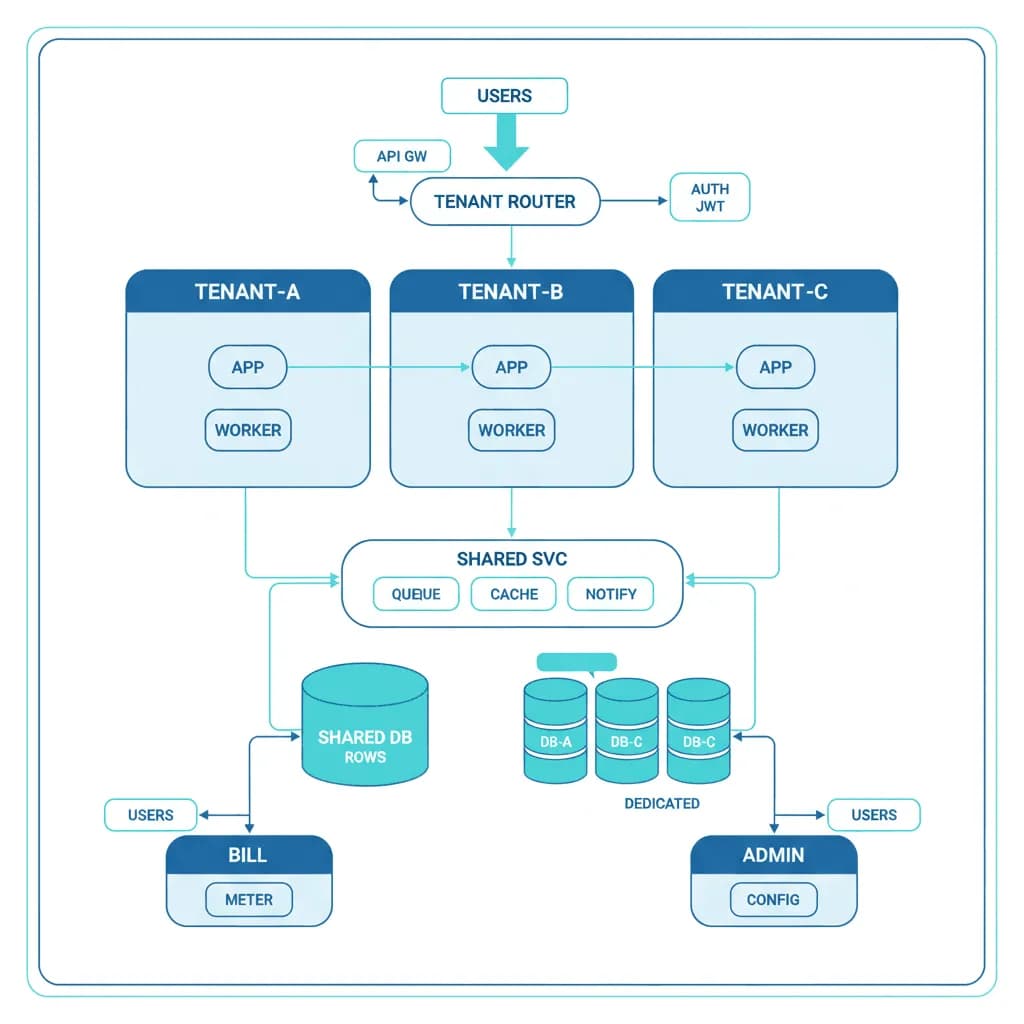
The system is organized into three layers. The tenant-aware gateway handles authentication, tenant resolution (via subdomain, JWT claim, or API key), and request routing. The application layer operates entirely within tenant context — every query, every cache key, every queue message is scoped to the resolved tenant. The data layer enforces isolation at the storage level through row-level security policies, connection pooling per tenant, and encrypted-at-rest partitioning.

Core Components
  • Tenant Management Service: Handles provisioning, onboarding workflows, custom domain mapping, theme/branding configuration, and per-tenant feature flags. Exposes an internal API for tenant lifecycle events (created, suspended, deleted)
  • Tenant Context Propagator: Middleware that resolves tenant identity from the request (subdomain, JWT, header) and injects tenant context into every downstream call — database connections, cache keys, queue messages, log entries
  • Data Isolation Engine: Implements the chosen isolation model. For RLS: PostgreSQL policies that filter every query by tenant_id. For schema-per-tenant: dynamic connection routing with connection pool management. For database-per-tenant: provisioning automation with Terraform/Pulumi
  • Billing & Metering Service: Event-driven usage tracking with per-tenant aggregation. Integrates with Stripe Connect or custom billing engines. Supports multiple pricing models (per-seat, usage-based, tiered, hybrid)

Design Decisions & Trade-offs

RLS vs. Schema-per-Tenant vs. Database-per-Tenant
MW defaults to RLS (shared database, row-level security) for most SaaS products. It's the simplest to operate — one migration path, one connection pool, one backup strategy. Schema-per-tenant makes sense when tenants need custom schema extensions (rare) or when regulatory requirements demand provable isolation. Database-per-tenant is reserved for enterprise deals where the customer contractually requires dedicated infrastructure. We've shipped all three — the choice depends on your compliance posture and tenant count.
Subdomain vs. Path-Based Tenant Resolution
Subdomains (acme.yourapp.com) are cleaner for white-label products and allow per-tenant TLS certificates. Path-based (yourapp.com/acme/) is simpler to implement and avoids wildcard DNS complexity. MW recommends subdomain resolution for B2B SaaS with white-label requirements, path-based for internal multi-tenant tools.
Shared Feature Flags vs. Per-Tenant Configuration
We use a two-layer feature flag system: global flags control rollout across the platform, tenant-level overrides let you enable beta features for specific customers or disable features for tenants on lower-tier plans. Edge Config or LaunchDarkly backs this with sub-millisecond reads.
Tenant-Aware Caching
Every cache key must be scoped to tenant_id. This sounds obvious, but cache key collisions across tenants are one of the most common multi-tenant bugs. We enforce this through a cache key factory that prefixes tenant context automatically.
Multi-Tenant SaaS Architecture - System Architecture Diagram

System Architecture Overview

Technology Choices

LayerTechnologies
ComputeNode.js (NestJS), Python (FastAPI), containerized on ECS Fargate or Kubernetes
DataPostgreSQL with RLS, Redis (tenant-scoped), S3 (tenant-partitioned buckets)
IdentityClerk, Auth0, or Okta with tenant-scoped organizations
BillingStripe Connect (marketplace model), Stripe Billing (metered subscriptions)
ObservabilityDatadog with tenant-dimension tags, structured logging with tenant_id on every entry

When to Use / When to Avoid

Use WhenAvoid When
Building a B2B platform serving 10+ customers from shared infrastructureEach customer requires fully dedicated infrastructure (compliance/contractual)
You need white-label branding, custom domains, and per-tenant feature controlYou have fewer than 3 customers — a simpler per-customer deployment may suffice
Usage-based or tiered pricing requires per-tenant meteringThe product is a consumer app with user-level accounts, not organization-level tenants
You want one deployment pipeline, one monitoring stack, one on-call rotationTenants have fundamentally different schemas or business logic (not just configuration)

Our Approach

MW treats multi-tenancy as a cross-cutting concern, not a feature. We implement tenant context propagation at the middleware level so application code never manually filters by tenant — it's enforced by the framework. Our RLS implementations include automated test suites that attempt cross-tenant data access on every CI run. We've built multi-tenant platforms serving 500+ tenants on shared infrastructure with zero data leakage incidents, and we've migrated single-tenant monoliths to multi-tenant architectures using the strangler fig pattern.

Related Blueprints

Related Case Studies

Related Technologies
SaaS DevelopmentCloud SolutionsAI Development

Need Help Implementing This Architecture?

Our architects can help design and build systems using this pattern for your specific requirements.

Get In Touch


Contact UsSchedule Appointment