Back to Architecture Patterns
InfrastructureEnterprise
Security-First Architecture
Security isn't a feature you add after launch. It's an architectural property — either the system was designed for it, or it wasn't.
|
Discuss This Architecture3 topics covered
Infrastructure
Category
Enterprise
Complexity
Financial Services, Healthcare
Industries
3+
Technologies

When You Need This
You're operating in a regulated industry where a data breach means fines, lawsuits, and loss of customer trust — not just a PR incident. Or you're building enterprise software where security questionnaires, SOC 2 audits, and penetration test reports are prerequisites for closing deals. You need an architecture where security is structural — zero trust networking, encryption at every layer, least-privilege access, comprehensive audit trails, and automated compliance checks — not a checklist applied after the system is built.

Pattern Overview
Security-first architecture embeds security controls at every layer of the system: network (zero trust, micro-segmentation), identity (centralized IAM, MFA, short-lived tokens), data (encryption at rest and in transit, field-level encryption, key rotation), application (input validation, OWASP protections, dependency scanning), and operational (audit logging, SIEM integration, incident response automation). The architecture assumes breach — it's designed to limit blast radius, detect compromise quickly, and maintain audit trails that support forensic investigation.

Reference Architecture
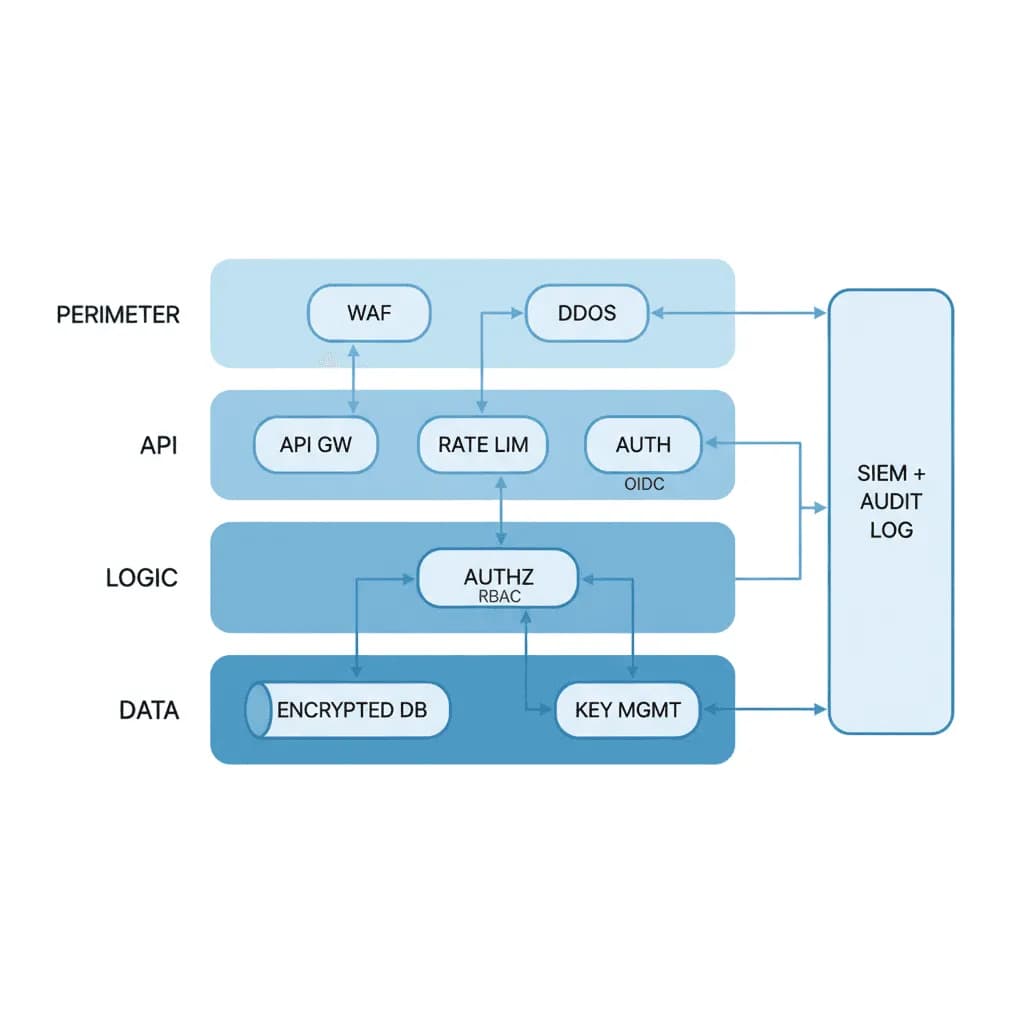
The architecture implements defense in depth across five layers. Network layer: zero trust with mutual TLS between services, no implicit trust based on network location. Identity layer: centralized identity provider (Okta, Auth0, Clerk) with MFA, RBAC/ABAC policies, and short-lived tokens (15-minute JWTs, not session cookies). Data layer: envelope encryption with AWS KMS or Vault, field-level encryption for PII, and data classification tags. Application layer: WAF, input validation, CSRF/XSS protection, rate limiting, and dependency vulnerability scanning. Operations layer: centralized audit logging, SIEM correlation, automated compliance checks, and incident response playbooks.
Core Components
- Identity & Access Management: Centralized IdP (Okta, Auth0, Clerk) with SSO, MFA, and SCIM provisioning. RBAC for coarse-grained permissions, ABAC for fine-grained (e.g., "can access records in own department"). Service-to-service authentication via mTLS or signed JWTs — no shared API keys between services
- Encryption Engine: Envelope encryption — data is encrypted with a data encryption key (DEK), the DEK is encrypted with a master key (KEK) in AWS KMS or HashiCorp Vault. Key rotation on schedule (90 days) without re-encrypting existing data. Field-level encryption for sensitive columns (SSN, credit card, health data) with application-level decrypt
- Audit & Compliance Pipeline: Every state change, access attempt, and administrative action is logged to an append-only audit store (immutable S3, CloudTrail, or custom audit service). Logs are structured (JSON), searchable, and retained per compliance requirements (7 years for financial, 6 years for HIPAA). Automated compliance checks run daily against CIS benchmarks and flag drift
- Threat Detection & Response: WAF (AWS WAF, Cloudflare, Vercel Firewall) at the edge for OWASP Top 10 protection. SIEM (Datadog Security, Splunk, Elastic Security) correlates events across services to detect anomalous patterns. Automated incident response: suspicious login triggers account lockout, data exfiltration pattern triggers network isolation

Design Decisions & Trade-offs
Zero Trust vs. Perimeter-Based Security
Zero trust (never trust, always verify — regardless of network location) is the modern standard, but it's more complex to implement than perimeter-based security (trust everything inside the VPC). MW implements zero trust for all new systems — the overhead of mTLS and per-request authorization is minimal compared to the blast radius reduction. For legacy systems, we implement zero trust at the API gateway and gradually extend inward.
RBAC vs. ABAC
Role-Based Access Control (RBAC) is simpler — assign roles, roles have permissions. Attribute-Based Access Control (ABAC) is more expressive — "can access records where department = user.department AND classification <= user.clearance". MW starts with RBAC and adds ABAC rules for specific use cases (multi-tenant data isolation, hierarchical access, dynamic policies). Most systems need a mix: RBAC for broad strokes, ABAC for fine-grained edge cases.
Encryption: Application-Level vs. Database-Level
Database-level encryption (TDE, AWS RDS encryption) protects against physical theft and unauthorized disk access but not against SQL injection or compromised application credentials — the database decrypts on read. Application-level field encryption protects sensitive fields end-to-end — the database never sees plaintext. MW applies database-level encryption universally (it's free on AWS) and adds application-level field encryption for PII and financial data where compliance requires it.
Compliance Automation vs. Manual Audits
Manual compliance audits (quarterly SOC 2 reviews, annual pen tests) are necessary but insufficient — they catch issues after the fact. MW builds automated compliance checks that run continuously: infrastructure configuration validation against CIS benchmarks (Prowler, ScoutSuite), dependency vulnerability scanning in CI/CD (Snyk, Trivy), and policy-as-code (OPA/Rego) for deployment guardrails. Manual audits validate the automation.
System Architecture Overview
Technology Choices
| Layer | Technologies |
|---|---|
| Identity | Okta, Auth0, Clerk, AWS IAM, HashiCorp Vault (secrets) |
| Network | Istio mTLS, AWS PrivateLink, VPC peering, Vercel Firewall, Cloudflare WAF |
| Encryption | AWS KMS, HashiCorp Vault, application-level (NaCl/libsodium) |
| Audit | CloudTrail, Datadog Audit, custom audit service (append-only S3 + Athena) |
| SIEM | Datadog Security, Splunk, Elastic Security, AWS Security Hub |
| Compliance | Prowler, ScoutSuite, Snyk, Trivy, OPA/Rego, Vanta (SOC 2 automation) |
When to Use / When to Avoid
| Use When | Avoid When |
|---|---|
| Regulated industry: financial services, healthcare (HIPAA), government (FedRAMP) | Internal tool with no sensitive data and no compliance requirements |
| Enterprise deals require SOC 2, ISO 27001, or HIPAA compliance | You're building an MVP where security basics (HTTPS, auth, input validation) suffice |
| The system processes PII, financial data, or health records | Over-engineering security adds months to delivery with no compliance mandate |
| Breach would cause significant financial or reputational damage | The cost of security controls exceeds the cost of a potential breach (risk assessment) |
Our Approach
MW embeds security into the development lifecycle, not as a gate at the end. Our infrastructure templates include encryption, audit logging, and IAM policies by default — teams opt out of security controls (with justification), not opt in. We run automated OWASP ZAP scans in CI, dependency vulnerability checks on every PR, and infrastructure compliance checks on every Terraform apply. For compliance-heavy engagements, we deliver a "compliance package" alongside the system: SOC 2 evidence collection automation, audit log retention policies, incident response runbooks, and penetration test-ready documentation.

Related Blueprints
- AI-Powered Security Operations Center — AI-driven threat detection and automated incident response
- GDPR Compliance Data Platform — Data mapping, consent management, and right-to-erasure automation
- Zero Trust Network Architecture — Full zero trust implementation with micro-segmentation
- Automated Penetration Testing Platform — Continuous automated security testing
- Healthcare HIPAA Compliance System — HIPAA-specific controls for healthcare platforms

Related Case Studies
- Contextual Encryption — Application-level field encryption with context-aware key management
- Okta SSO/SCIM Integration — Enterprise authentication with SSO and automated user provisioning
- GDPR-Compliant AI Chat — Multi-model chat platform with GDPR data handling and retention controls
Related Technologies
CybersecurityCloud SolutionsDigital Consulting
Related Architecture Patterns
Explore more design patterns and system architectures

Infrastructure
Serverless-First Architecture
Pay for what you use, scale to zero when you don't, and stop managing servers entirely — but know when the economics stop working.
AdvancedView

Infrastructure
On-Off Scaling Architecture
Don't pay for idle GPUs. Provision compute just-in-time, process the workload, and tear it down — turning capital expense into a per-job operating cost.
AdvancedView

Infrastructure
Edge Computing & IoT Architecture
Process data where it's generated. Not everything needs to round-trip to the cloud — and for many IoT workloads, it can't.
EnterpriseView
Frequently Asked Questions
Security-first architecture embeds threat modeling, access controls, encryption, and audit logging into the system design from day one, which MicrocosmWorks has found reduces vulnerability remediation costs by 10-15x compared to retrofitting security onto an existing system. When security is bolted on afterward, it typically results in inconsistent enforcement, blind spots in logging, and architectural constraints that prevent implementing certain controls without major refactoring. MicrocosmWorks begins every project with a threat modeling workshop that identifies the security controls needed before any code is written.
MicrocosmWorks implements zero-trust through mutual TLS between all services, identity-aware proxies that authenticate every request regardless of network origin, micro-segmented network policies that restrict lateral movement, and continuous device and session posture evaluation. We deploy service meshes like Istio or Linkerd that enforce mTLS and authorization policies at the infrastructure level so individual application teams cannot accidentally bypass security controls. Our zero-trust implementations include real-time access logging and anomaly detection that flags unusual access patterns for immediate investigation.
MicrocosmWorks configures centralized secrets management using HashiCorp Vault or AWS Secrets Manager with environment-specific access policies, automated secret rotation schedules, and audit trails that log every secret access event. We eliminate hardcoded secrets through dynamic secret generation where database credentials, API keys, and certificates are issued on-demand with short TTLs and automatically revoked when no longer needed. Our CI/CD pipelines inject secrets at runtime rather than baking them into container images or configuration files, ensuring secrets never appear in source code, logs, or artifact registries.
MicrocosmWorks designs security-first architectures that map directly to compliance controls in SOC 2, HIPAA, PCI-DSS, GDPR, and ISO 27001, with automated evidence collection that generates audit-ready documentation continuously rather than in a last-minute scramble before assessments. We implement policy-as-code using tools like Open Policy Agent that enforces compliance rules at the infrastructure and application layers, so violations are blocked automatically rather than caught in manual reviews. Our compliance consulting rates range from $20-$50/hr for teams that need help mapping security controls to specific regulatory requirements.
MicrocosmWorks builds security guardrails into the developer platform itself—pre-configured secure base images, automated dependency vulnerability scanning in CI, and infrastructure-as-code templates with security best practices baked in—so developers get security by default without extra effort. We avoid security theater that slows teams down without reducing risk, instead focusing on high-impact controls like automated secret detection in pre-commit hooks, runtime application self-protection, and security-reviewed deployment pipelines. Our goal is that developers experience security as a platform feature rather than a bureaucratic gate, which we achieve by investing heavily in tooling automation during the initial architecture build.
Need Help Implementing This Architecture?
Our architects can help design and build systems using this pattern for your specific requirements.
Get In Touch