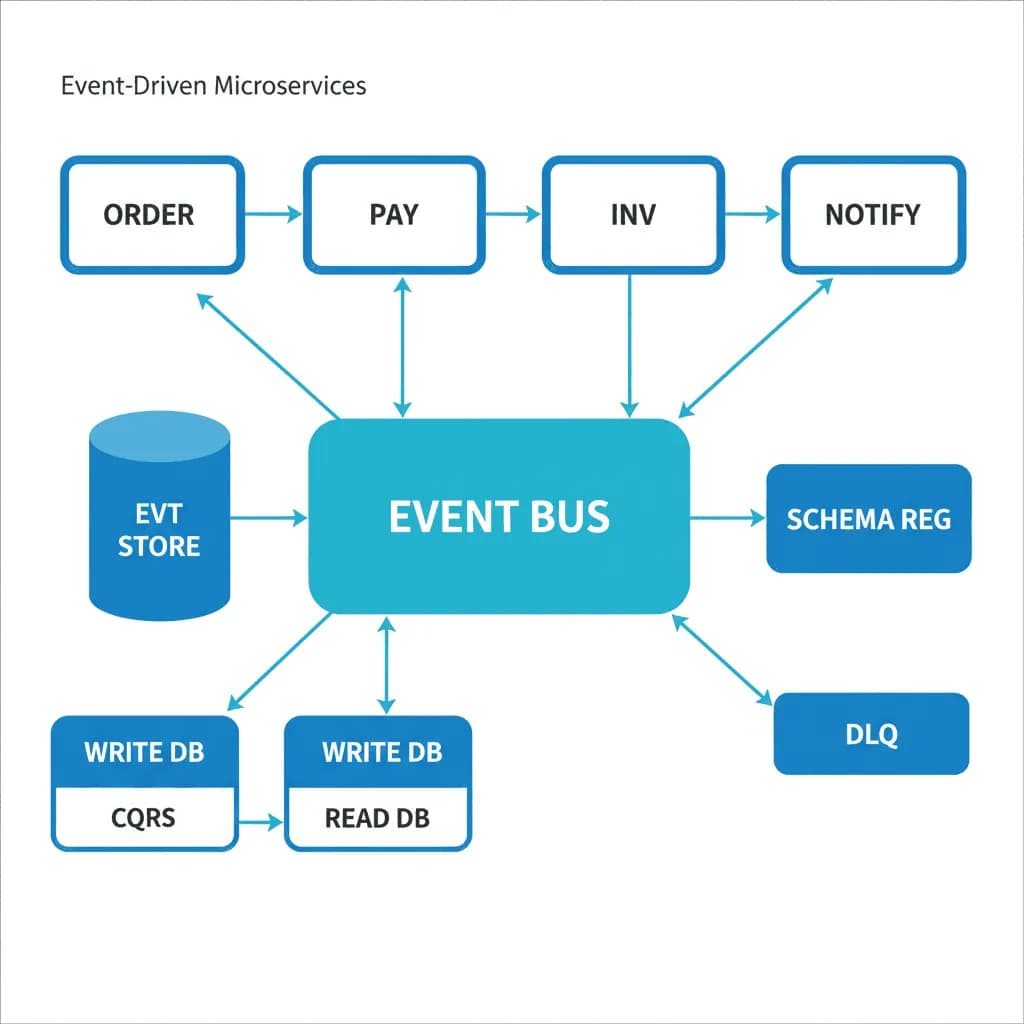
Event-Driven Microservices
Decouple everything. Let services communicate through events, not expectations about each other's uptime.

When You Need This
Your monolith is becoming a deployment bottleneck — every change requires coordinating across teams, and a bug in billing takes down the entire application. Or you're building a new system where different capabilities evolve at different rates: order management changes weekly, but inventory logic changes quarterly. You need services that can be developed, deployed, and scaled independently, communicating through events rather than synchronous API calls that create cascading failure chains.

Pattern Overview
Event-driven microservices decompose a system into independently deployable services that communicate primarily through asynchronous events. Each service owns its data, publishes domain events when state changes, and reacts to events from other services. This eliminates temporal coupling — Service A doesn't need Service B to be running to do its work. The pattern incorporates CQRS (Command Query Responsibility Segregation) to separate write and read models, event sourcing to capture the full history of state changes, and saga orchestration to manage multi-service transactions without distributed locks.
Reference Architecture
The architecture centers on an event backbone (Kafka, EventBridge, or NATS) that routes domain events between services. Each service has three boundaries: a command handler that processes incoming requests and emits events, a query handler that serves read-optimized projections, and an event processor that reacts to events from other services. A saga orchestrator coordinates multi-step business processes (e.g., order fulfillment) by listening for events and issuing compensating commands when steps fail.
- Event Bus / Broker: Kafka (for high-throughput, ordered events), EventBridge (for AWS-native routing), or NATS (for low-latency). Handles event routing, replay, and dead-letter queuing
- Domain Services: Each owns a bounded context — Order Service, Payment Service, Inventory Service, Notification Service. Each has its own database (polyglot persistence) and publishes domain events on state change
- Saga Orchestrator: Manages long-running business transactions. Implements compensating transactions for rollback (e.g., if payment fails after inventory reservation, release the reservation). Can be choreography-based (services react to events) or orchestration-based (central coordinator)
- Event Store: Append-only log of all domain events. Enables full audit trail, temporal queries ("what was the order state at 2 PM?"), and event replay for rebuilding projections or debugging
Design Decisions & Trade-offs

System Architecture Overview
Technology Choices
| Layer | Technologies |
|---|---|
| Compute | Node.js (NestJS), Python (FastAPI), Go — per service based on workload characteristics |
| Messaging | Apache Kafka (MSK), AWS EventBridge, NATS JetStream, RabbitMQ |
| Data | PostgreSQL (transactional), DynamoDB (key-value), Redis (caching/locks), EventStoreDB |
| Orchestration | Temporal (workflow orchestration), AWS Step Functions, custom saga coordinator |
| Observability | OpenTelemetry (distributed tracing), Datadog, Jaeger, structured logging with correlation IDs |
When to Use / When to Avoid
| Use When | Avoid When |
|---|---|
| Multiple teams need to deploy independently on different cadences | Your team is < 5 engineers — a well-structured monolith is simpler to operate |
| Different parts of the system have different scaling characteristics | You're building an MVP and need to ship fast — distributed systems are slow to build |
| You need strong audit trails and event replay capabilities | Every operation requires synchronous, strongly consistent responses |
| The domain has natural bounded contexts (orders, payments, inventory) | The domain is tightly coupled — splitting it creates a distributed monolith |
Our Approach
MW doesn't decompose into microservices by technical layer (API service, data service, auth service). We decompose along domain boundaries using DDD (Domain-Driven Design) bounded contexts. Before writing code, we run an event storming workshop to map domain events, commands, and aggregates — this determines service boundaries, not technology preferences. We've migrated monoliths to event-driven architectures for enterprise clients, and the most common lesson is: start with fewer, larger services and split later, not the other way around.
Related Blueprints
- Enterprise Workflow Automation with AI Agents — Event-driven orchestration of AI agent workflows
- Serverless Microservices Transformation — Decomposing monoliths into serverless event-driven services
- CRM Integration & Automation Suite — Event-driven sync between CRM systems
- Supply Chain Visibility Platform — Event-driven tracking across supply chain stages
Related Case Studies
- Enterprise HR/ERP Platform — Multi-service enterprise platform with event-driven integrations
- CRM Integration — Event-driven Zoho CRM sync with idempotent event handlers
- Subscription Management — Multi-platform subscription events with webhook orchestration
Related Architecture Patterns
Explore more design patterns and system architectures

Multi-Tenant SaaS Architecture
One codebase, hundreds of tenants, zero data leakage — the foundation of every scalable SaaS business.

Data-Intensive Platform Architecture
When your competitive advantage is in your data, the platform that collects, transforms, stores, and surfaces that data is the most important thing you'll build.

Security-First Architecture
Security isn't a feature you add after launch. It's an architectural property — either the system was designed for it, or it wasn't.
Need Help Implementing This Architecture?
Our architects can help design and build systems using this pattern for your specific requirements.
Get In Touch